
Field Notes
One Artist’s Ongoing War Against Horticultural Tyranny
People often imagine that an artist's greatest challenges happen in the studio.
They picture blank canvases, dried-up inspiration, impossible color decisions, or paintings that simply refuse to become what they were meant to be.
Those challenges certainly exist. What they don't know is that many artists also wage entirely different battles once they step outside the studio door.
Mine just happen to involve plants. Not the lovely, cooperative sort that bloom politely and stay where they're planted. No, I seem to have been chosen by a rather exclusive society of botanical bullies.
I come from a family with a peculiar inheritance. Some families pass down blue eyes. Others pass down musical talent or cherished recipes. The women in my family inherit adversaries. My mother's nemesis was wisteria.
If your only acquaintance with wisteria comes from glossy gardening magazines, you probably imagine graceful lavender blossoms draped romantically over old pergolas while someone nearby enjoys a glass of iced tea.
This is propaganda. Real wisteria has loftier ambitions.
My mother fought hers for years at her home in North Carolina. Every season she cut it back, dug it out, and declared cautious victories. Finally, convinced she had won, she and my father left for a month-long trip.
When they returned, the wisteria had apparently spent the month plotting. Somehow it had traveled underground, emerged on the other side of their Victorian home, climbed the siding, discovered a crack no wider than a pencil lead, and politely inserted a fresh green shoot into their bedroom.
I have always imagined my mother standing there, suitcase still in hand, looking at that little vine as if to say, "You've got to be kidding." And the wisteria, no doubt, looking rather pleased with itself.
As it turns out, I inherited my mother's remarkable talent. Not for growing beautiful gardens—though I've sort of done that too—but for attracting weeds with impossible determination. In Pennsylvania it was bishop's weed. And lamium. And, as if in tribute to family tradition, wisteria.
When we moved to Rochester five years ago, I admired some delicate pale pink flowers twining through the garden and thought, What pretty little morning glories. The bindweed and I have never discussed my first impression, but I suspect it still tells the story at family gatherings.
Still ignorantly enchanted by those pink flowers, I happily designed and planted the front garden beds of our home. Today they are lush with lavender, nepeta, and little boxwoods tucked between the mounds of purple blossoms. The nepeta, delighted with life, has become far larger than I ever imagined and now threatens to swallow the boxwoods entirely. The lavender is thriving too, though it has begun sharing its space with uninvited guests creeping up through its woody stems.
The beds are beautiful. They're also hiding an underground rebellion. Bindweed doesn't simply grow. It infiltrates.
You pull it, and somewhere below the surface an invisible committee calmly approves next week's agenda. You dig carefully, certain you've removed every last root, only to discover that a fragment the size of a shoelace has already begun drafting replacement vines.
Garden books speak optimistically about "persistent management." This is a charming phrase, isn't it? It suggests that persistence belongs exclusively to the gardener. The bindweed has other ideas.
For years I’ve held firmly to one principle: "I will never use Roundup." It felt like a line I simply wouldn't cross.
Then one afternoon, after pulling yet another bucketful of bindweed (with a number of those sweet pink blossoms still attached) and noticing it cheerfully reappearing exactly where I had started, I drove to the garden center.
I bought the Roundup. I didn't feel victorious. I didn't even feel guilty. I felt... tired of negotiating. There comes a point in every long conflict when diplomacy has failed.
This is not surrender. This is strategic realignment. The bindweed has my respect. But it cannot have my garden.
I love my garden. I believe in pollinators, compost, healthy soil, and the quiet miracle of watching things grow. But I have also reached an age where I recognize that my joy is found less in heroic acts of weeding and more in sitting with a cup of coffee while the bees ignore my opinions entirely.
Perhaps the studio has taught me something the garden is only now asking me to believe: not everything beautiful requires struggle.
Although if the bindweed could stop teaching for just one season... .
..that would be lovely.
Note to the reader: I have yet to use the Roundup. I'm still afraid of it.
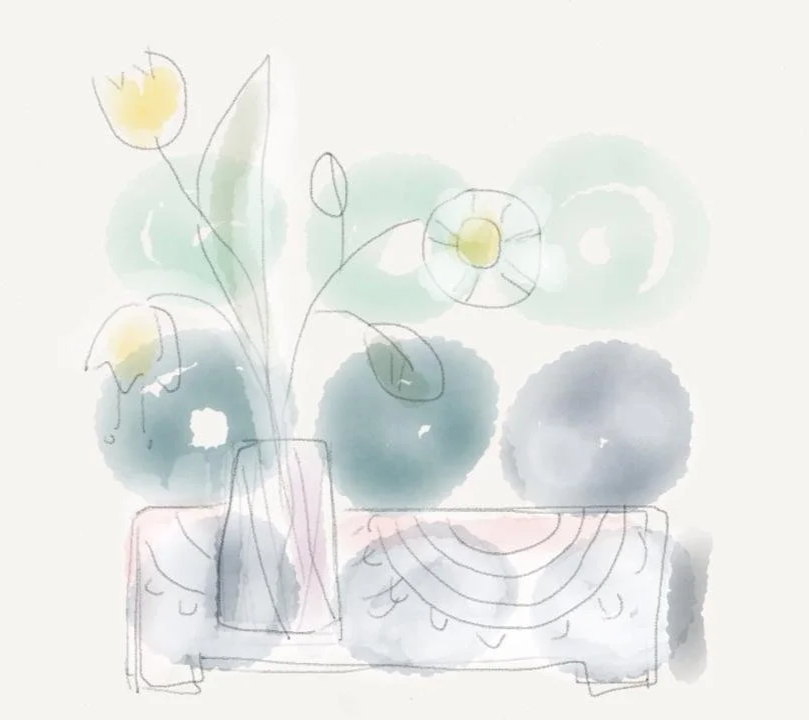
from a sketchbook